
Why Your Fan Attracts Dust Instead of Blowing It Away – The Science, Nature, and Opportunities Behind the Paradox
At first glance, it seems counterintuitive: you have a fan that’s always spinning, moving air at high speed—yet its blades and protective cage collect dust faster than almost any surface in your home. Isn’t a fan supposed to blow dust away, not gather it? This common observation is not only intriguing but also rooted in real science. In fact, the phenomenon you’re witnessing is related to concepts like electrostatic attraction, airflow dynamics, and boundary layer effects. Interestingly, similar phenomena occur in nature—such as how sandstorms form, or how certain surfaces in deserts attract fine dust despite high winds.
Let’s explore why this happens, what science calls it, how nature uses similar mechanisms, and how this knowledge could be applied for good.
The Science Behind Dust Collection on a Spinning Fan
1. Boundary Layer Effect
Even though the fan blades are spinning rapidly, each blade has a thin layer of air called the boundary layer—a region where air velocity slows down near the surface due to friction. In this layer, the air is almost still. Dust particles suspended in the air can settle and stick to this slow-moving or stationary layer.
2. Electrostatic Attraction
As the fan blades spin continuously, friction between air particles and the plastic or metal fan blades can generate static electricity. This gives the blades a slight electrical charge, causing them to attract tiny, lightweight particles like dust. It’s similar to how a balloon rubbed against your hair can pick up paper bits.
3. Turbulent Airflow and Vortex Formation
Fans don’t push air in a straight line; they create turbulent patterns and even small vortexes near the blades and cage. Some dust gets trapped in these low-pressure pockets of circulating air, which makes it easier for particles to cling to surfaces instead of being pushed away.
Natural Parallels: How Wind Both Blows and Attracts Dust
Dust storms and sandstorms are dramatic natural examples where wind doesn’t always “clean” the environment—it can actually concentrate and carry dust over large distances.
Sandstorms in Deserts
In deserts like the Sahara, strong winds lift dust particles into the air due to a process called saltation (bouncing of sand grains). These winds can create swirling eddies and vortexes (like mini-tornadoes), pulling fine dust upward and depositing it elsewhere. Sometimes, a single wind system both lifts and drops dust, depending on terrain, humidity, and obstacles. 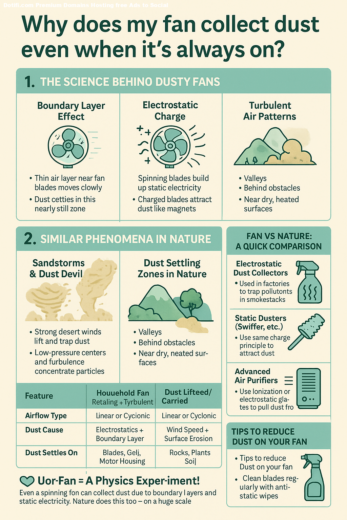
Dust Devil Phenomena
Small whirlwinds called dust devils occur on hot dry surfaces. Though they involve rapid spinning air, they collect dust in their low-pressure cores and move it vertically. This shows that even moving air can accumulate particles under the right conditions.
Comparison: Household Fan vs. Natural Wind Systems
| Feature | Household Fan | Natural Wind (e.g., Desert Storms) |
|---|---|---|
| Air Motion | Controlled, rotational, often turbulent | Linear or cyclonic, chaotic, high-speed |
| Dust Behavior | Attracted to static-charged surfaces | Lifted, suspended, or deposited |
| Key Factor for Dust Catching | Electrostatics + Boundary Layer | Saltation + Air Pressure Variations |
| Common Dust Traps | Blade surface, cage | Rocky outcrops, vegetation, low-wind zones |
| Cleaning Mechanism | Needs manual cleaning | Natural rain or long-term air shifts |
How Can This Effect Be Used for Good?
Understanding how dust clings to moving objects can lead to useful applications, such as:
1. Air Purification Systems
Some high-end fans use electrostatic precipitation to trap particles. Instead of filtering air mechanically, they charge particles and attract them to collector plates—similar to how your fan collects dust but in a controlled and purposeful way.
2. Static-Based Cleaning Tools
This effect is used in static dusters (like Swiffer), which generate slight static charges to pick up particles from surfaces.
3. Pollution Control
Factories and power plants use electrostatic scrubbers to remove pollutants from exhaust gases—an industrial-scale version of your dusty fan phenomenon.
4. Scientific Research
Dust collection patterns are studied in climate science, especially how dust travels across oceans to fertilize forests (e.g., Saharan dust reaching the Amazon).
Conclusion: A Fan’s Dusty Irony is a Window Into Natural Forces
Your dusty fan isn’t broken—it’s demonstrating a subtle and fascinating interplay of electrostatics, fluid dynamics, and environmental science. What looks like a household nuisance actually mirrors natural systems on a much grander scale. From sandstorms to static dusters, the same principles apply.
Instead of just wondering why your fan gets dirty, take a moment to appreciate that it’s quietly performing a physics experiment every day—one that nature has been running for millennia.
Would you like an infographic or visual explanation for this? I can also help with tips to reduce dust buildup on your fan.
You said:
ChatGPT said:
Great! Here’s an infographic-style breakdown of why your fan collects dust, the science behind it, and how it compares to natural systems like sandstorms. It’s formatted in sections so you can post or convert this into a visual easily (on PowerPoint, Canva, etc.).
🌪️ Why Does My Fan Collect Dust Even When It’s Always On?
An Infographic Explaining the Science, Nature, and Usefulness of Dust Attraction
🔬 1. The Science Behind Dusty Fans
🌀 Boundary Layer Effect
-
Thin air layer near fan blades moves slowly
-
Dust settles in this nearly still zone
⚡ Electrostatic Charge
-
Spinning blades build up static electricity
-
Charged blades attract dust like magnets
🌬️ Turbulent Air Patterns
-
Fans create vortexes and eddies
-
Some air recirculates dust toward the fan instead of blowing it away
🏜️ 2. Similar Phenomena in Nature
🌪️ Sandstorms & Dust Devils
-
Strong desert winds lift and trap dust
-
Low-pressure centers and turbulence concentrate particles
🗻 Dust Settling Zones in Nature
-
Despite strong wind, dust settles in:
-
Valleys
-
Behind obstacles
-
Near dry, heated surfaces
-
🔄 3. Fan vs Nature: A Quick Comparison
| Feature | Household Fan | Natural Winds (e.g., Desert) |
|---|---|---|
| Airflow Type | Rotating + Turbulent | Linear or Cyclonic |
| Dust Cause | Electrostatics + Boundary Layer | Wind Speed + Surface Erosion |
| Dust Settles On | Blades, Grill, Motor Housing | Rocks, Plants, Soil |
| Dust Lifted/Carried | Minimal – tends to settle | Massive – over oceans, continents |
✅ 4. How This Knowledge Can Be Used
🏭 Electrostatic Dust Collectors
-
Used in factories to trap pollutants in smokestacks
-
Industrial version of a dusty fan
🧼 Static Dusters (Swiffer, etc.)
-
Use same charge principle to attract dust
💨 Advanced Air Purifiers
-
Use ionization or electrostatic plates to pull dust from air
🧽 5. Tips to Reduce Dust on Your Fan
-
🧼 Clean blades regularly with anti-static wipes
-
🌿 Use an air purifier in the room
-
🚫 Avoid placing fans near open windows
-
📏 Elevate or angle fan to reduce floor-level dust draw
-
🔌 Try anti-static blade spray (safe for electronics)
💡 Summary: Your Fan = A Physics Experiment!
Even a spinning fan can collect dust due to boundary layers and static electricity. Nature does this too—on a huge scale. Understanding the why helps you not only clean smarter but also appreciate the powerful forces at play in your everyday environment.